Workplaces and events
Festival Severe Thunderstorm Watch Plan for Organizers
Use a festival severe thunderstorm watch plan to assign weather monitoring, decision authority, shelter communication, vendor coordination, and departure boundaries.
A watch-stage festival organizer plan for weather monitoring, decision authority, arrivals, programming, vendors, temporary structures, shelter messages, staggered departures, and warning boundaries.
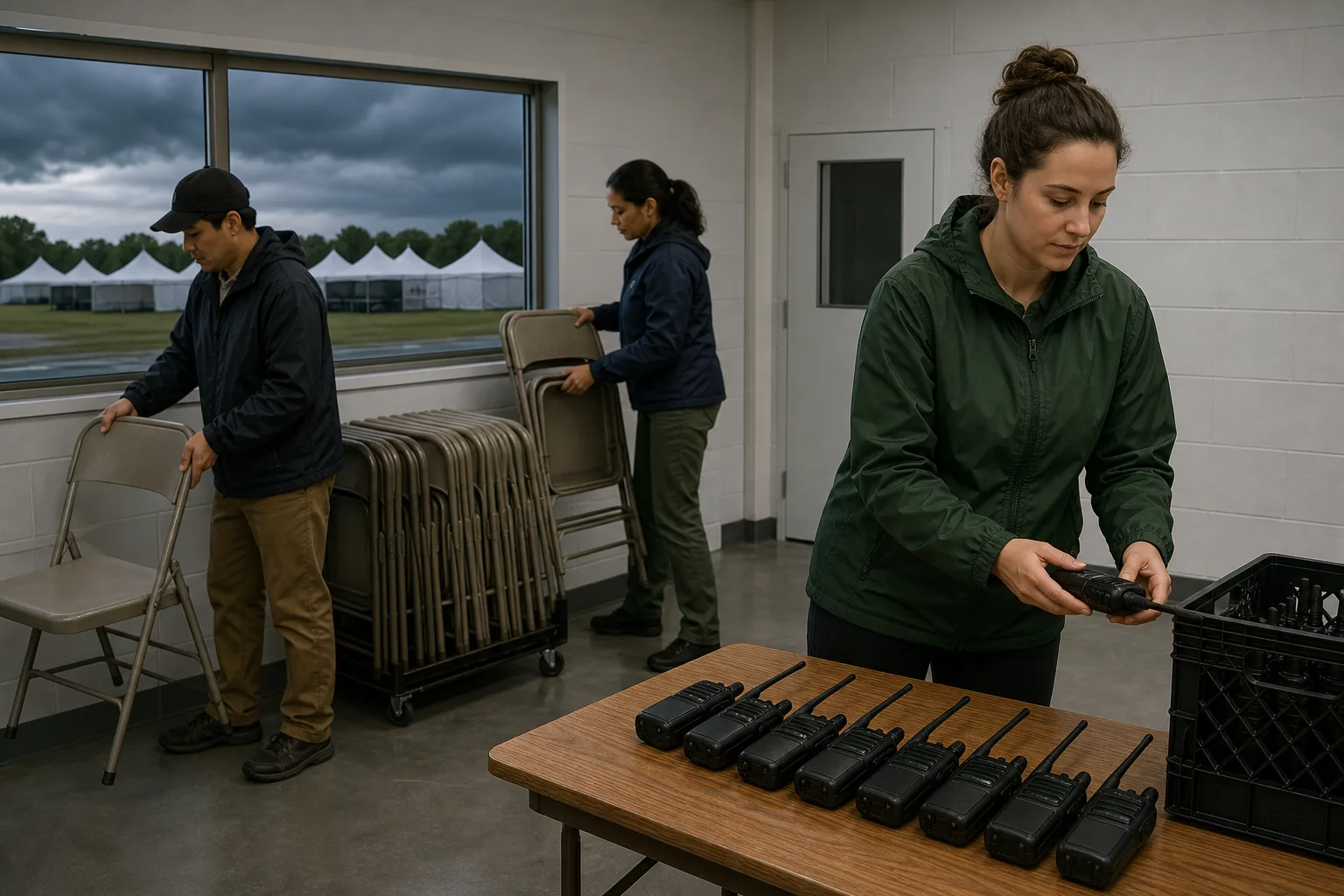
A festival severe thunderstorm watch plan should assign a weather lead, decision authority, vendor and staff communication, shelter or hold options, arrival and parking messages, and a process for changing programming before storms arrive. A watch means severe thunderstorms are possible in and near a broad area; it is not by itself a cancellation rule, an evacuation order, or a guarantee that severe weather will reach the grounds. Use the free ZIP checker for current Severe Thunderstorm Watch status for the event ZIP. If a Warning, thunder, lightning, or local instruction arrives, follow weather.gov, public-safety partners, venue policy, and local alerts over this evergreen planning guide.
Direct answer for festival organizers
Write the plan around decisions the event can make before time is short. Who monitors the watch? Who can hold gates, pause a stage, stop new arrivals, move volunteers, contact vendors, speak to public safety, or send an attendee message? Who is the backup if the event director is unavailable? A dispersed outdoor festival has too many moving pieces for “we’ll decide if it gets bad” to be a plan.
Ready.gov describes mass gatherings as events where a lot of people come together, including music festivals, concerts, parades, and big sports games, and says those events can make safety and resource management harder. That is the festival problem: people are spread across entrances, vendor rows, food areas, lawns, tents, parking lots, restrooms, backstage areas, and transit points. The watch stage is the chance to organize those pieces while conditions may still be manageable.
This article does not decide when to cancel, evacuate, reopen, refund, close parking, or remove a structure. Those decisions belong to the event’s authority, public-safety partners, permits, contracts, venue rules, and official instructions.
What the Watch changes for arrivals and programming
A watch should trigger a readiness huddle before the audience is fully committed. The huddle should include the event lead, weather lead, operations lead, stage or programming lead, vendor coordinator, parking or transportation lead, communications lead, and public-safety liaison if the event has one. The group should answer: what is happening now, what could change, what decisions have deadlines, and who communicates each change?
Arrivals are a special festival problem. People may be driving, walking from remote parking, waiting at gates, standing in security lines, or carrying children and supplies across open ground. The plan should decide what message goes to ticket holders before more people arrive and who approves that message. It should not claim live certainty that the grounds are safe or unsafe unless official information and event authority support that decision.
Programming also has lead times. A stage pause, vendor hold, volunteer redeployment, accessible-shuttle change, or parking adjustment may take longer than a phone call. Use the watch period to identify those lead times. The what to do when a Severe Thunderstorm Watch is issued guide covers the basic prepare-not-panic posture; the festival plan turns that posture into operational choices.
Vendor, tent, and open-ground constraints
Temporary setups create coordination risk. Vendor tents, shade canopies, merchandise tables, food lines, portable restrooms, temporary fencing, sound positions, and open lawns may not offer meaningful protection from severe wind, hail, or lightning. This guide does not make engineering claims about any tent, stage, or structure. Instead, the plan should ask: which areas are exposed, who can tell vendors to pause sales or secure only what they are trained and authorized to secure, and where do staff and attendees go if conditions change?
Vendor communication should be separate from attendee communication. Vendors may need earlier notice because they have cash boxes, food safety steps, equipment, vehicles, or staff to manage. Do not bury them in a public announcement and assume they understood. The vendor coordinator should have a direct route to reach them and a backup if cellular service becomes overloaded.
Open ground deserves special attention. Ready.gov’s location-planning guidance says outdoor locations such as sports fields or golf courses need specific plans for rapid short-term shelter for thunderstorms and lightning. A festival should identify nearby substantial buildings or other shelter options with local authorities and venue owners before gates open. If suitable shelter is limited, that limitation should be part of the decision discussion, not discovered when thunder starts.
Shelter and announcement planning before storms arrive
NWS says a Warning means take action and shelter in a substantial building. For a festival, an announcement at that stage must already have a destination and route strategy. “Seek shelter” is not enough if thousands of people do not know where to go, which exits are open, whether cars are appropriate, or how accessible routes are handled.
Before storms arrive, draft short message variants. One message may prepare attendees: “A Severe Thunderstorm Watch is in effect for the area. Event staff are monitoring conditions. Please stay aware of announcements.” Another may change operations: “Programming is paused while staff review weather and site conditions.” A warning-stage or active-lightning message should be controlled by the event’s official communication plan and public-safety partners.
Avoid fake precision. Do not promise that a storm will arrive at a specific minute unless that comes from your trusted operational weather source and event authority. Do not say “all clear” just because one rain shower ended. A watch can cover a broad time and area, and local warnings or additional storms may still matter.
How to handle staggered departures without live status claims
Departure can create its own hazard: traffic, pedestrians in open lots, ride-share queues, buses, volunteers directing cars, and people trying to retrieve belongings. A watch plan should consider whether departures can be staged, delayed, redirected, or messaged before a warning forces urgency. The answer depends on the site and official partners; this guide only frames the decision.
If the event asks people to leave, the message should say who decided it, what route or process to use, and what not to do. If the event asks people to hold, the message should say where and for how long the next update is expected if the event can support that. If the event is not changing operations during the watch, the plan should still keep staff ready for a warning-stage change.
For organizers responsible for several event ZIPs, vendor sites, parking areas, or related locations, Thunderstorm Watch Pro may be useful as an optional Severe Thunderstorm Watch email-monitoring layer. It is not warning delivery, SMS, push, radar, forecasts, public-safety dispatch, or a replacement for official alerts and event decision authority.
Boundary between Watch preparation and Warning action
The boundary must be written clearly. A watch is when the festival prepares, coordinates, monitors, and readies messages. A Warning, thunder, lightning, dangerous conditions, or a local instruction is when the event follows its protective-action plan and official direction. If the event has a public-safety agency, venue command post, emergency manager, or weather vendor in the decision loop, the plan should say how that loop works.
NWS lightning toolkits for organizations and large venues support written lightning safety planning. FEMA’s special-event course overview supports pre-event planning, planning teams, event hazard analysis, and incident response concepts. Those sources support planning structure; they do not give your festival a universal reopen rule.
After the event, hold a short review. Did the watch reach the weather lead? Did vendors get the message? Were announcements understandable without readable signage? Did accessible routes work? Did parking become the weak point? Did the event wait too long for a decision deadline? Turn those answers into a revised plan before the next festival day.
For general workplace authority and communication structure, use the severe thunderstorm watch workplace emergency plan. For other event and workplace contexts, return to the workplaces and events hub or the main guide library outside the pressure of an active alert.
FAQ
Questions answered in this guide
Does a festival watch plan say when to cancel?
Who should monitor weather for a festival?
Can Thunderstorm Watch Pro replace local alerts?
Official sources
Source ledger
These sources support the guide copy and structured data.
- Understand Severe Weather Alerts
NWS says a Severe Thunderstorm Watch means be prepared and stay informed, while a Severe Thunderstorm Warning means take action and shelter in a substantial building.
- Toolkits for County, Communities, Organizations and Large Venues
NWS describes lightning-safety toolkits for outdoor venues, organizations, communities, and large venues that can create draft written lightning safety plans for review.
- Mass Gathering Incidents | Ready.gov
Ready.gov says mass gatherings include music festivals, concerts, parades, and big sports games, and that such events can make safety and resource management harder.
- Plan for Locations | Ready.gov
Ready.gov says plans should account for locations people visit, local alerts, building alert systems, shelter-in-place plans, temporary sheltering supplies, and rapid short-term shelter for outdoor locations during thunderstorms and lightning.
- FEMA - Emergency Management Institute Course IS-15.B
FEMA's course overview supports special-event pre-event planning, planning teams, event hazard analysis, and incident response concepts without prescribing cancellation policy.